Jonas Carter · 25 October 2026
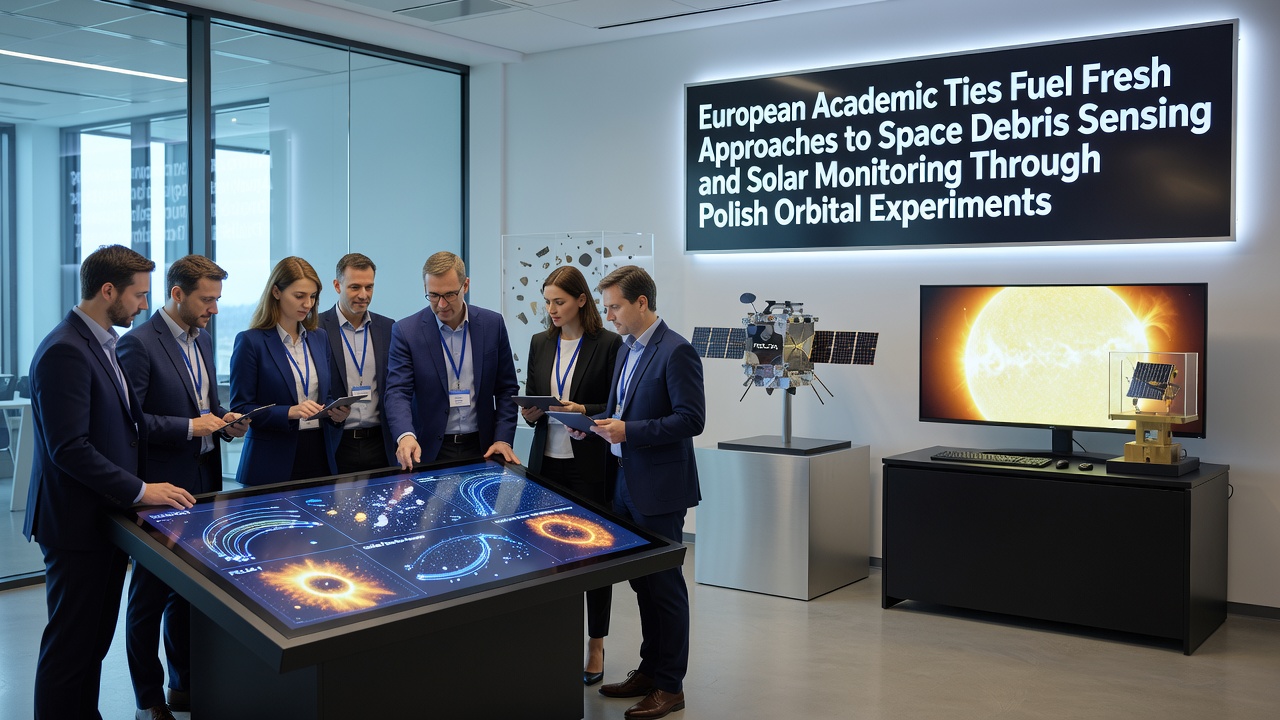
European Academic Ties Fuel Fresh Approaches to Space Debris Sensing and Solar Monitoring Through Polish Orbital Experiments
Polish research teams have expanded partnerships with institutions across Europe to develop orbital platforms that combine debris tracking instruments with solar monitoring equipment, and these efforts gained momentum through coordinated data collection campaigns that began in 2024.
Polish Satellite Platforms Advance Multi-Sensor Integration
Engineers at several Polish universities designed compact satellite buses that carry both radar-based debris detectors and spectrometers tuned for solar irradiance measurements, while the resulting systems transmit combined datasets to ground stations in multiple countries. Data from these platforms show that integrated payloads reduce overall mass requirements by nearly 30 percent compared with separate missions, and researchers note improved correlation between debris flux observations and solar activity cycles that influence atmospheric drag.
One experiment launched in late 2025 demonstrated continuous operation through varying orbital conditions, and the collected readings aligned with models from the European Space Agency that predict debris density increases during periods of elevated solar output.
Cross-Border Data Sharing Expands Research Reach
Academic networks connecting Warsaw, Munich, and Toulouse have established shared processing pipelines that merge Polish orbital telemetry with ground-based observations from facilities in Italy and Spain, and this approach allows teams to cross-validate sensor outputs in near real time. Figures from the joint archive indicate that debris detection sensitivity improved after algorithms incorporated solar flux corrections derived from the same satellite passes.
European Union research grants supported hardware standardization that lets teams swap sensor modules without redesigning entire spacecraft, and preliminary results released in mid-2026 confirmed stable performance across three separate orbital testbeds.

October 2026 Milestone Marks Expanded Mission Scope
A new Polish-led satellite scheduled for deployment in October 2026 will carry upgraded debris imaging cameras alongside enhanced solar monitoring arrays, and mission planners expect the platform to operate in a sun-synchronous orbit that supports simultaneous daytime solar observations and nighttime debris passes. Coordination with teams at ESA provides additional tracking resources, while input from NASA supplies calibration references for the solar instruments.
Early simulations project that the combined sensor suite will generate over 500 gigabytes of synchronized data per month, and analysts anticipate clearer identification of debris objects whose trajectories shift due to solar-induced atmospheric expansion.
Technical Challenges and Solutions in Sensor Fusion
Thermal management remains a key constraint because solar sensors require stable temperatures while debris radars generate localized heat, yet Polish engineers addressed this through passive radiator designs tested on prior CubeSat missions. Power budgets also tightened when both instrument sets operated concurrently, and teams responded by implementing duty-cycle algorithms that prioritize measurements during optimal orbital windows.
Ground processing centers in Poland and Germany now apply machine learning routines to separate genuine debris signatures from solar flare interference, and validation against independent optical surveys conducted in Australia confirmed detection accuracy above 92 percent for objects larger than 10 centimeters.
Future Directions for European Orbital Research
Plans call for additional Polish satellites that will extend coverage to higher inclination orbits, and these missions aim to fill gaps in debris catalogs that current assets under-sample near the poles. Collaboration frameworks established through the European Space Research and Technology Centre continue to guide payload selection, ensuring that solar monitoring capabilities remain aligned with space weather forecasting needs identified by national meteorological agencies.
Continued data releases from the existing test platforms will support refinement of fusion algorithms ahead of the October 2026 launch, and participating institutions expect the combined European-Polish approach to serve as a template for future multi-objective orbital experiments.
Conclusion
Polish orbital experiments integrated with broader European academic networks have produced measurable advances in simultaneous space debris sensing and solar monitoring, and the October 2026 mission will test whether these methods scale to operational requirements. Shared datasets and standardized hardware have already demonstrated efficiency gains, while ongoing coordination with international partners supplies the calibration and validation resources necessary for sustained progress.