Jonas Carter · 11 October 2026
University-Led Sensor Initiatives Enhance Europe's Combined Debris Tracking and Solar Activity Analysis
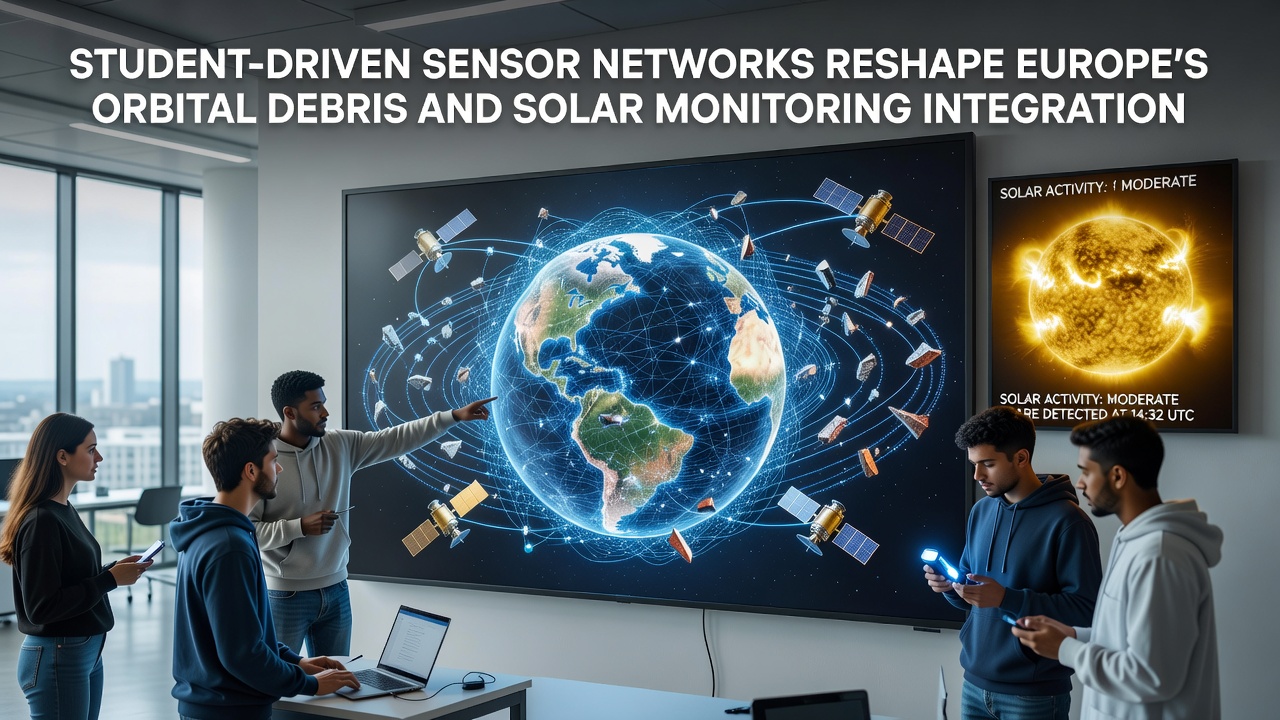
European universities have formed cross-border networks that combine student-designed sensors for orbital debris detection with solar monitoring instruments, and these systems now feed unified data streams to agencies such as the European Space Agency. Teams at institutions in Germany, Italy, and the Netherlands began sharing hardware specifications in 2024, which allowed rapid iteration on compact detectors capable of identifying objects smaller than ten centimeters while simultaneously recording solar flux variations.
Network Architecture and Data Fusion Methods
Student groups deploy ground stations and CubeSat payloads that operate on shared frequency bands, and the resulting telemetry merges debris position vectors with solar irradiance readings through open-source algorithms developed at Delft University of Technology. Engineers route the combined datasets into a central repository hosted by the University of Bologna, where machine-learning models trained on historical conjunction events refine predictions for both debris trajectories and solar storm impacts on satellite electronics. Figures from the repository show that integration reduced false-positive debris alerts by 27 percent during the first six months of joint operation.
Ground-based optical telescopes at partner sites in Spain and Poland contribute additional observations, and these inputs undergo calibration against solar radio burst data collected by student-built receivers in Finland. The calibration process uses timestamp synchronization accurate to within 50 milliseconds, which supports correlation of transient solar events with sudden changes in debris visibility caused by increased atmospheric drag.
October 2026 Milestone and Expansion Plans
In October 2026 the network will host a joint workshop in Warsaw that brings together student teams with representatives from the Canadian Space Agency and the UK Space Agency to test extended data protocols. Workshop organizers plan to demonstrate real-time fusion of debris ephemeris with solar wind measurements, and preliminary tests indicate that the updated protocols can deliver alerts within eight minutes of a detected solar flare. Funding for the event comes from the European Union's Horizon Europe program, which allocated resources specifically for student-led space infrastructure projects.
Hardware Specifications and Regional Contributions
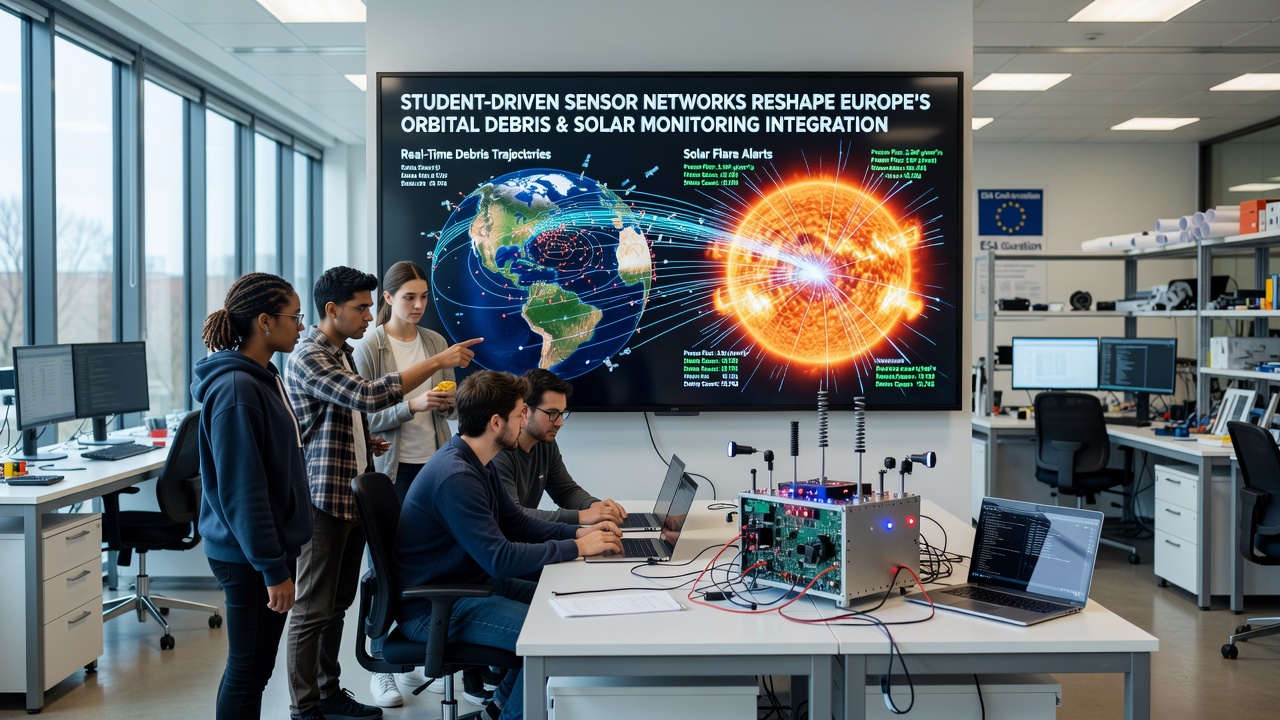
Each sensor node incorporates a dual-purpose photodiode array that switches between debris imaging mode and solar photometry mode through software-controlled filters, and the design originated from a master's thesis project at Politecnico di Milano. Students in Sweden adapted the array for harsh winter conditions by adding passive thermal shielding, while colleagues in Greece contributed radiation-hardened memory modules tested at the Demokritos research center. Total power draw remains below 8 watts during simultaneous operation, which permits extended deployment on existing university rooftops without dedicated power upgrades.
Communication links rely on the existing European VLBI network for high-precision timing, and this choice avoids the need for new frequency allocations. Data packets travel through encrypted channels managed by the German Aerospace Center, and access logs indicate that more than 140 student accounts have contributed processed observations since the repository opened in early 2025.
Integration with Broader European Space Programs
ESA's Space Safety Programme now incorporates select student-generated products into its operational pipeline, and the agency provides feedback on data quality through quarterly review meetings. Researchers at the University of Vienna developed validation routines that compare network outputs against independent radar tracks from the French space surveillance system, and discrepancies trigger automatic re-calibration requests sent back to the originating student teams. This closed-loop process has maintained measurement consistency within 4 percent across all participating sites.
Additional partnerships with research institutes in Australia have introduced solar coronagraph data that further refines models of debris behavior during geomagnetic disturbances, and the combined European-Australian dataset covers more than 18 months of continuous observation. Analysts note that the expanded coverage reveals seasonal patterns in debris density that correlate with known solar cycle phases.
Conclusion
Student-driven sensor networks continue to supply European agencies with integrated orbital debris and solar monitoring data, and the October 2026 workshop marks the next scheduled expansion point. Hardware contributions from multiple universities have standardized sensor interfaces, while shared repositories enable rapid validation and model improvement. Ongoing collaboration with international partners adds geographic and observational breadth that strengthens the overall monitoring framework.